Ava_Veled, I remembered the Mitki series of paintings where the Mitki bring their ears to Van Gogh, take Mayakovsky's pistol, send Brezhnev to Afghanistan... one more is missing: "The Mitki teach Ava_Veled to smile for the camera..."
In this case, you can smile at the photographer, i.e., at yourself, during a liberating dialogue but that's probably also a scene from there ))) By the way, the model looks quite tense, right
Ava_Veled, why a camera? A photographer! That's one thing. A camera is a piece of glass and iron, and behind any camera there's a person.
Do you never smile at yourself? Are you always so serious with yourself? (I'm not saying specifically about this photo that you should have smiled in it, no, everything is perfect here, I just wanted to bring up the topic in general.)
Secondly, the situation when a person looks into the camera is already rehearsed, it doesn't matter whether you're serious or smiling.
Any portrait photoshoot is essentially fake, because the person knows they're being photographed. Yes, you can evoke emotions, distract them somehow, etc., etc., but initially, it's already a rehearsal for life. And they probably washed their hair, thought about what to wear, etc., etc.
I went to two portrait exhibitions in the last month. One was painting, and the other was contemporary British. A portrait, the second one is a photo. There are no smiles. At all. Not a single one. In my opinion, this is abnormal. People often smile in real life. And a little self-irony never hurt anyone.
Alhimovich, a smile is a kind of defense against further explanations. If you smile, you're okay. A smile is almost always an act. People are used to smiling when they see someone with a camera. It's commonplace. People don't know what else to do. A smile and you're "normal."
"Antitheaterism in Photography. Svetlana Poleshchuk Yale University Press has released a 400-page book by Michael Fried titled "Why Photography Matters as Art as Never Before." We offer you a review of some of its chapters."
"...Antitheaterism is possible, oddly enough, in frontal portraits, the essence of which lies precisely in the model being aware of the camera's presence and consciously responding to it." We read in Barthes: "How can one look intelligent without thinking about anything intelligent, for example, while looking at a black piece of plastic? In such cases, the gaze, without seeing, seems to linger on something internal." That is, this "intelligent look" again has nothing to do with the photographer's intention, being an echo of the model's inner state.
"And this is especially evident in frontal photographs, which Barthes treated with great interest: 'What can I say about photographs where I see white coats, stretchers, bodies stretched out on the ground, broken glass, and so on and so forth. Ah, if only there were at least one glance in them, the gaze of the subject, if only someone were looking at me in these photographs! For Photography has the power (which it is increasingly losing these days, since the frontal position is usually considered archaic) to look me straight in the eye (here is another difference from cinema: in film, no one ever looks straight; this is forbidden by fiction).'" Barthes's thoughts thus anticipated the popularity of frontal poses in modern photography."
Ava_Veled, smile at us. We're all standing behind your camera, after all. Through it, the film, the scanner, the bunch of wires, the monitor, smile at us. Good four-armed Alexander
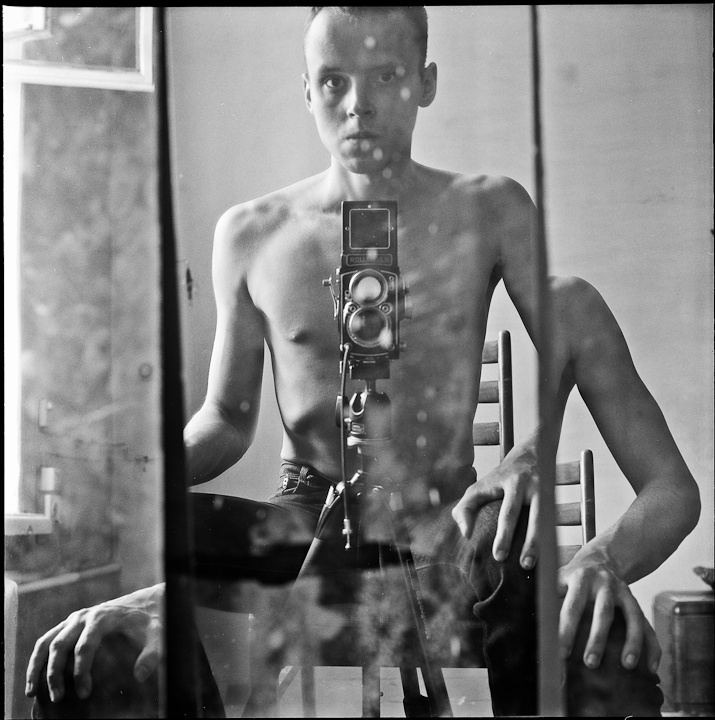
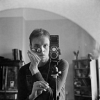

The camera turned out well. It's authentic. )
But I really want to see a smile.
I really like the work. Such huge hands. I want to start talking in Mayakovsky's poems.
Good idea.
By the way, the model looks quite tense, right
ash,
No smile, and so many questions: where is IT? How is that possible?
There's a smile. No questions.
Do you never smile at yourself? Are you always so serious with yourself?
(I'm not saying specifically about this photo that you should have smiled in it, no, everything is perfect here, I just wanted to bring up the topic in general.)
Secondly, the situation when a person looks into the camera is already rehearsed, it doesn't matter whether you're serious or smiling.
Any portrait photoshoot is essentially fake, because the person knows they're being photographed. Yes, you can evoke emotions, distract them somehow, etc., etc., but initially, it's already a rehearsal for life. And they probably washed their hair, thought about what to wear, etc., etc.
I went to two portrait exhibitions in the last month. One was painting, and the other was contemporary British. A portrait, the second one is a photo. There are no smiles. At all. Not a single one. In my opinion, this is abnormal. People often smile in real life. And a little self-irony never hurt anyone.
"Antitheaterism in Photography. Svetlana Poleshchuk
Yale University Press has released a 400-page book by Michael Fried titled "Why Photography Matters as Art as Never Before." We offer you a review of some of its chapters."
"...Antitheaterism is possible, oddly enough, in frontal portraits, the essence of which lies precisely in the model being aware of the camera's presence and consciously responding to it." We read in Barthes: "How can one look intelligent without thinking about anything intelligent, for example, while looking at a black piece of plastic? In such cases, the gaze, without seeing, seems to linger on something internal." That is, this "intelligent look" again has nothing to do with the photographer's intention, being an echo of the model's inner state.
"And this is especially evident in frontal photographs, which Barthes treated with great interest: 'What can I say about photographs where I see white coats, stretchers, bodies stretched out on the ground, broken glass, and so on and so forth. Ah, if only there were at least one glance in them, the gaze of the subject, if only someone were looking at me in these photographs! For Photography has the power (which it is increasingly losing these days, since the frontal position is usually considered archaic) to look me straight in the eye (here is another difference from cinema: in film, no one ever looks straight; this is forbidden by fiction).'" Barthes's thoughts thus anticipated the popularity of frontal poses in modern photography."
The article is posted on photoscope.by
Currently Living, Rolleiflex2.8c
Good four-armed Alexander